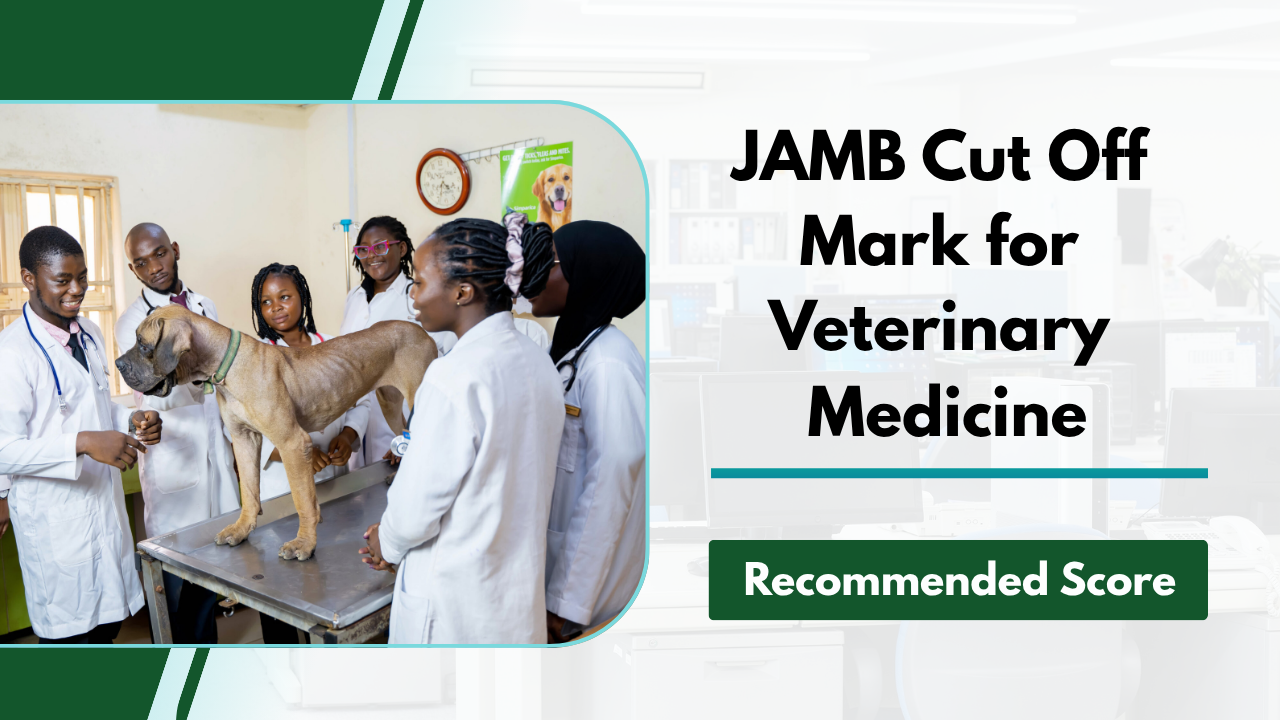
JAMB Cut Off Mark for Veterinary Medicine
If you are interested in studying Veterinary Medicine, it is a competitive professional programme, so meeting the set JAMB score is an important part of the admission process. However, meeting the JAMB cut-off mark does not automatically mean that you will be offered admission. Your chosen university, the number of applicants, O'Level results, and other admission requirements can also affect your chances. For the 2026/2027 academic session, candidates should understand the difference between the general JAMB benchmark and the score required to remain competitive for Veterinary Medicine at a particular university.
Follow the information provided in this guide to learn everything about the JAMB cut-off mark for Veterinary Medicine, the scores to target, universities offering the programme, admission requirements, what to do if you meet the required score, and the steps to take after meeting the JAMB score. It also explains what you can do if your score is below the requirement of your preferred university.
What Is the JAMB Cut-Off Mark for Veterinary Medicine?
For the 2026/2027 admission session, the set JAMB cut-off mark range for Veterinary Medicine varies by institution, with many universities requiring candidates to score around 200 and above, while highly competitive institutions may require considerably higher scores. This means that applicants who score 200 and above are eligible to proceed to the next step of the admission process.
This does not mean applicants are automatically admitted. They need to meet other requirements. The general JAMB benchmark should not be confused with the departmental or course-specific score used by a university. A candidate who meets the general benchmark may still need a higher score to compete successfully for Veterinary Medicine. Candidates should check the requirements of their preferred university rather than assuming that one score applies to every institution.
What Does the JAMB Cut-Off Mark Mean and Why Does It Matter?
The JAMB cut-off mark is a minimum score used to determine whether a candidate can be considered for admission. For Veterinary Medicine, the cut-off mark helps universities determine which candidates are eligible to compete for the available admission spaces. It is also important to remember that meeting the cut-off mark does not guarantee admission. Candidates must ensure they meet the O'level requirements, Direct Entry requirements, and have the right JAMB subject combinations.
The cut-off mark matters because Veterinary Medicine has limited admission spaces and attracts candidates with strong Science backgrounds. Your JAMB score can affect:
- Whether you are eligible to apply for the course.
- The universities available to you.
- Your competitiveness against other applicants.
- Your chances of being shortlisted for the next stage of admission.
- Your options if the course is highly competitive.
A higher JAMB score generally gives you more options, although other admission requirements still matter.
Universities Offering Veterinary Medicine in Nigeria
Some Nigerian universities offering Veterinary Medicine include:
- Ahmadu Bello University (ABU), Zaria — 260+
- University of Abuja — 240+
- Bayero University Kano (BUK) — 250+
- University of Benin (UNIBEN) — 265+
- Federal University of Agriculture, Zuru (FUA-ZURU) — 220+
- Federal University of Agriculture, Abeokuta (FUNAAB) — 255+
- University of Ibadan (UI) — 275+
- University of Ilorin (UNILORIN) — 265+
- University of Jos (UNIJOS) — 250+
- University of Maiduguri (UNIMAID) — 230+
- Joseph Sarwuan Tarka University, Makurdi — 230+
- Usmanu Danfodiyo University, Sokoto (UDUS) — 240+
- Michael Okpara University of Agriculture, Umudike (MOUAU) — 240+
- University of Nigeria, Nsukka (UNN) — 270+
What Is the JAMB Subject Combination for Veterinary Medicine?
The UTME subjects required for Veterinary Medicine are:
- Physics
- Chemistry
- Biology
English Language is compulsory in the JAMB UTME. Choosing the correct subjects is important because an incorrect combination can affect your eligibility for the course.
O'Level Requirements for Veterinary Medicine
Candidates generally need at least five relevant O'Level credit passes, including:
- English Language
- Mathematics
- Physics
- Chemistry
- Biology
These requirements may be obtained through recognised examinations such as WAEC, NECO or NABTEB. Some institutions may have additional requirements concerning the number of sittings or specific grades, so candidates should check their preferred university's admission requirements.
What to Do After Meeting the JAMB Cut-Off Mark
Meeting the cut-off mark is only the beginning of the admission process. After achieving the required score, candidates should:
- Confirm the university's current admission requirements.
- Check whether Veterinary Medicine is available for the admission session.
- Register for Post-UTME or the university's screening exercise where required.
- Upload or submit the required O'Level results.
- Prepare properly for Post-UTME if the university conducts an examination.
- Monitor the university's admission portal and JAMB CAPS.
- Ensure your personal and academic information is correct.
- Accept your admission on JAMB CAPS when an offer is made.
Do not assume that your admission is secured because your JAMB score is above the cut-off mark.
What If You Do Not Meet the Cut-Off Mark?
If your JAMB score is below the requirement of your preferred university, you still have options. You can:
- Check other universities with lower requirements.
- Consider changing your institution if JAMB and the university permit it.
- Consider another suitable course if necessary.
- Monitor supplementary admission opportunities.
- Check whether your score meets the requirements of another institution offering Veterinary Medicine.
- Follow official admission updates before making a decision.
Your options depend on the current requirements of universities offering the programme.
Career Opportunities For Veterinary Medicine Graduates
Veterinary Medicine graduates can work in different areas of animal health, agriculture, public health and research. Career opportunities include:
- Veterinary Doctor
- Veterinary Surgeon
- Animal Health Officer
- Public Health Veterinarian
- Livestock Health Specialist
- Veterinary Laboratory Officer
- Veterinary Researcher
- Animal Welfare Officer
- Government Veterinary Officer
- Veterinary Consultant
Veterinarians may work in veterinary clinics, farms, research institutions, government agencies, pharmaceutical organisations, food industries and other animal-related businesses.
Tips for Candidates Seeking Admission to Veterinary Medicine
- Aim for a high JAMB score.
- Study Physics, Chemistry and Biology thoroughly.
- Use the current JAMB syllabus when preparing.
- Practise past questions regularly.
- Meet the required O'Level subjects and grades.
- Check the cut-off mark of your preferred university.
- Prepare for Post-UTME where applicable.
- Keep realistic alternative universities in mind.
- Monitor JAMB CAPS and your university's admission portal.
- Always verify admission information from official sources.
The JAMB cut-off mark for Veterinary Medicine varies from one university to another, so candidates should not rely on a single score as a guarantee of admission. While a score of 200 may be enough for consideration at some institutions, highly competitive universities may require significantly higher scores. If you have already received your JAMB result, compare your score with the requirements of your preferred universities and choose your next step carefully. If you are still preparing for UTME, aim for the highest score you can achieve. Keep visiting this website for more updates, and always remember that the correct UTME subject combination, good O'Level results, Post-UTME or screening performance, and meeting your university's specific requirements can all contribute to your chances of gaining admission to study Veterinary Medicine.